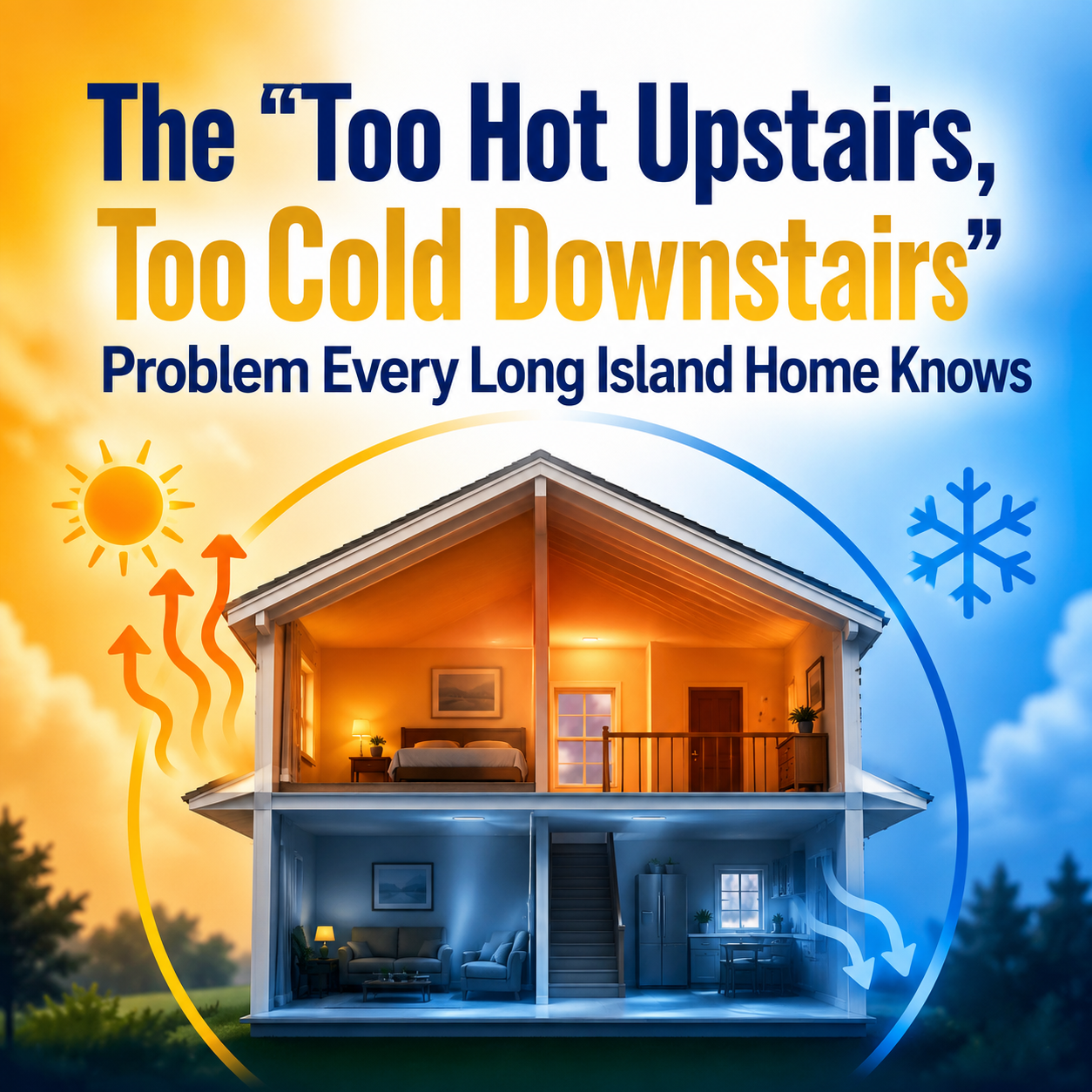
Is Your Upstairs Always Hot While the Downstairs Feels Like a Refrigerator?
If you own a two-story home on Long
Island, you've probably experienced this frustrating problem. Your air
conditioner seems to be running all day, yet the upstairs bedrooms remain
uncomfortably warm while the downstairs becomes chilly.
Many homeowners assume they need a
larger air conditioner or even an entirely new HVAC system. In reality, the
issue is often caused by airflow, system design, or maintenance—not necessarily
an aging AC unit.
Understanding why this happens can
help you solve the problem without spending more than necessary.
Why This Happens in Long Island Homes
Many homes throughout Suffolk County
and surrounding Long Island communities were built years ago with HVAC systems
designed differently than today's comfort standards.
Several factors contribute to uneven
temperatures.
Heat
Naturally Rises
Warm air always moves upward. During
Long Island summers, your second floor absorbs heat from the roof, attic, and
sunlight throughout the day. Even when your air conditioner is operating
correctly, your upstairs has a much larger cooling load.
Poor
Airflow
Your HVAC system depends on balanced
airflow.
Common airflow problems include:
- Dirty air filters
- Closed or blocked supply vents
- Furniture covering registers
- Leaky ductwork
- Dirty evaporator coils
- Weak blower performance
When airflow is restricted, cool air
never reaches the upper floor effectively.
Improper Duct Design
Many older homes simply weren't
designed for balanced air distribution.
If your upstairs receives less
conditioned air than the downstairs, temperature differences of 5–10 degrees
are common.
Inadequate
Attic Insulation
Your attic acts like a giant oven
during summer.
Poor insulation allows tremendous
amounts of heat to transfer into upstairs rooms, forcing your AC to work much
harder.
Incorrect
Thermostat Location
Most thermostats are installed on
the first floor.
Once the downstairs reaches the
desired temperature, the thermostat tells the system to shut off—even though
the upstairs may still be several degrees warmer.
Signs
Your HVAC System Needs Attention
You may have more than a comfort
issue if you notice:
- Upstairs bedrooms never cool properly
- AC runs constantly
- High electric bills
- Weak airflow upstairs
- Hot and cold spots throughout the home
- Certain rooms never reach the thermostat setting
These symptoms usually indicate an
airflow or HVAC performance problem.
Solutions
That Actually Work
Fortunately, there are several
effective ways to solve uneven temperatures.
Schedule
Professional HVAC Maintenance
A comprehensive tune-up can
identify:
- Dirty coils
- Low refrigerant
- Weak capacitors
- Restricted airflow
- Blower motor issues
- Drain problems
Routine maintenance often restores
cooling performance while improving efficiency.
Improve
Airflow
Simple adjustments may include:
- Replacing dirty air filters
- Cleaning supply and return vents
- Opening all registers
- Sealing leaking ductwork
- Cleaning evaporator and condenser coils
Better airflow allows conditioned
air to reach every room more evenly.
Install
a Zoning System
For larger two-story homes, zoning
is one of the best long-term solutions.
A zoning system uses separate
thermostats and motorized dampers to direct cooling where it's needed most.
Instead of cooling the entire home
equally, each floor receives the amount of conditioned air it actually
requires.
Upgrade
Your Thermostat
Smart thermostats can help improve
comfort through better scheduling and system control.
Some homes also benefit from
multiple temperature sensors that average readings from different rooms.
Add
Attic Insulation
Improving attic insulation and
ventilation reduces the heat entering your second floor.
This not only improves comfort but
also lowers energy consumption throughout the summer.
Should
You Replace Your Air Conditioner?
Not necessarily.
Many homeowners believe uneven
temperatures automatically mean their AC has failed.
In reality, replacing equipment
without fixing airflow or duct issues often results in the exact same problem.
A professional HVAC inspection can
determine whether your existing system simply needs repairs, maintenance,
balancing, or whether replacement is truly the most cost-effective option.
Why
Long Island Homes Experience This More Often
Long Island weather brings:
- Hot, humid summers
- Strong afternoon sun
- High attic temperatures
- Older housing stock
- Two-story colonial homes
- Seasonal humidity changes
These factors place significant
stress on residential cooling systems and make temperature imbalance one of the
most common HVAC complaints in the area.
Final Thoughts
If your upstairs feels like summer
while your downstairs feels like winter, you're certainly not alone. This is
one of the most common comfort complaints among Long Island homeowners, but it
doesn't always require a costly system replacement. In many cases, professional
maintenance, improved airflow, duct adjustments, insulation upgrades, or a
properly designed zoning system can restore balanced temperatures and improve
your home's overall efficiency. At K2 Cooling AND Heating, we help
homeowners throughout Long Island diagnose the real cause of uneven
temperatures and recommend solutions that provide lasting comfort—not
unnecessary expenses.